
Public Bodies Climate Change Duties Reporting Analysis Report
This month SSN published the 2024-25 Public Bodies Climate Change Duties Analysis Report on behalf of the Scottish Government.
The Sustainable Scotland Network (SSN) is Scotland’s public sector network on sustainability and climate change, with a secretariat based at ECCI.
The annual report provides a high-level analysis of the Public Bodies’ Climate Change Duties 2024/25 annual compliance reports and presents key findings on public sector corporate emissions, projects, renewables, emission targets, climate risk assessment and adaptation action.
The report also reflects on what has changed in 10 years of climate change duties reporting.
A message from SSN Chair, Dr John Wincott
“SSN is pleased to publish the annual analysis of the 2024/25 Public Bodies Climate Change Duties reports. Produced for the Scottish Government, our report provides a snapshot of the progress being made by public bodies in measuring and taking action on mitigation and adaptation, and highlights some of the challenges we face in reducing emissions – especially from heating public sector buildings – and adapting to the impacts of a changing climate – including developing and implementing resilience plans. This year’s report also marks ten years of mandatory climate change reporting by public bodies.
Looking forward, SSN will continue to support our many dedicated members across the public sector who complete mandatory reports and use this data to inform and accelerate projects and actions. We are grateful to all our members for continuing to deliver 100% submissions and continually improving the quality of reporting.”
Highlights
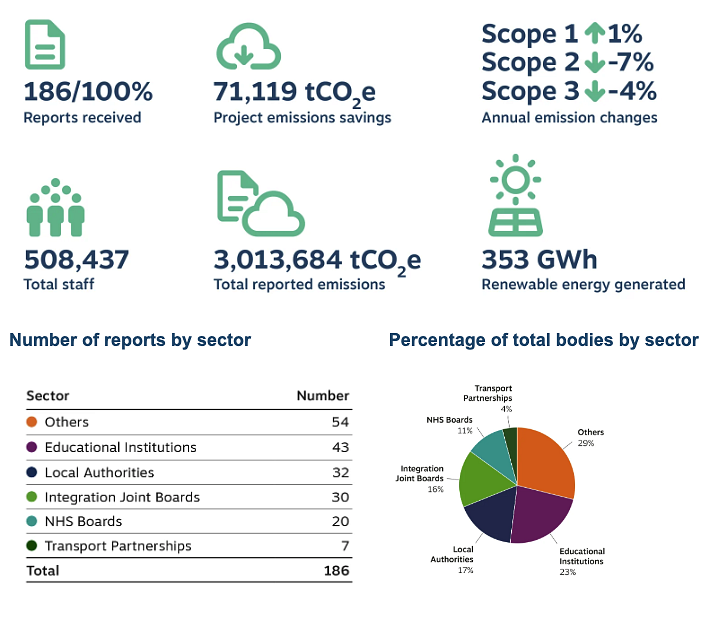
Headlines: Scope 1, 2 & 3
Scope 1 (direct) emissions are broadly unchanged since 2023/24.
- An overall 5% reduction since 2015/16 is driven primarily by an 8% net decrease in gas consumption.
- Warmer winters, combined with increasing public sector estate rationalisation and decarbonisation have contributed to reduced heating demand.
- Natural gas use is still the largest source of total reported emissions (25%) and represents 72% of scope 1 emissions.
- Fleet, which accounts for 20% of scope 1 emissions and 7% of total emissions, increased by 2% since 2023/24 and by 8% since 2015/16. This is despite some evidence of growing fleet decarbonisation.
Scope 2 (indirect) emissions reduced by 7% since 2023/24 and by 63% since 2015/16.
- Due mainly to decarbonisation of the UK electricity grid, however, consumption has decreased by nearly 15% in the last decade, due to energy efficiency measures and installation of renewable electricity infrastructure on the public estate, specifically solar panels.
Scope 3 (indirect) emissions present a more complex pattern.
- More bodies reporting additional emission sources and improvements in reporting methodologies.
- Following pronounced increases in recent years, procurement emissions were only 2% higher and commuting emissions were 2% lower when compared to 2023/24 (Neither emissions source was reported to any material degree prior to 2019/20).
- Although both sources are significantly under-reported, they account for one third of total emissions.
- Reported procurement emissions rank second overall contributing 24% of total emissions.